

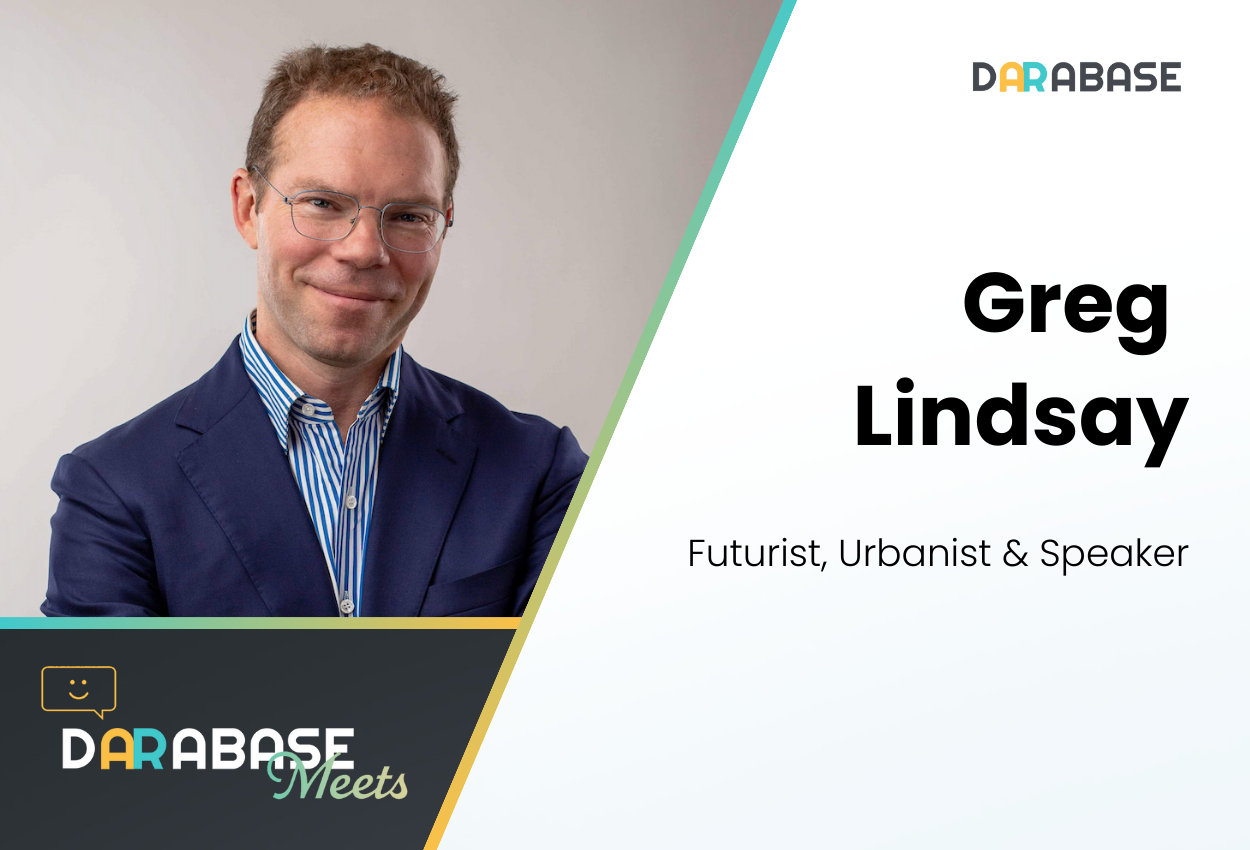

In a recent interview with Greg Lindsay, renowned urbanist and futurist, the discussion revolved around the future of urban environments, the implications of commercial control of content and the integration of new technologies into human-centric cities.
Preparing for future urban environments
The discussion began by looking at how cities need to prepare for new technologies. That might mean seizing the opportunities AR offers for improvements to placemaking, tourism, culture and community engagement. It will also, however, involve mitigating risks to physical safety and ensuring the propriety and fairness of content. Lindsay believes that cities will need to set standards and embed best practice into the use of immersive technologies and negotiate the interface between private property ownership and those serving digital content, probably in partnership with companies such as Darabase. He pointed out that for cities pressed for time and cash, this will be difficult, not least because they will need to map digital content, something that has no tangible presence and will be served through proprietary technologies.
As cities continue to evolve, Lindsay’s insights underscored the need for careful consideration and proactive management of new technologies. By understanding the potential benefits and drawbacks of technology, urban planners and policymakers can work towards creating more equitable and human-centric urban spaces.
Implications of commercial control
The discussion covered the implications of commercial control of AR and how the different regulatory regimes across the globe – notably the EU, the Sinosphere and the US – will impact this. Lindsay believes the regulations will impede true globalisation of content but that might not be a bad thing if it means limiting disinformation from bad actors:
“I’m a little concerned about somebody across the globe being able to drop AR content into a given location given that it could be very adversarial… Local barriers and limits could be necessary.”
Lindsay noted the potential for exclusive corporate partnerships between those who control AR hardware and businesses that have the power to dominate the AR advertising space. For instance, “I’m interested in what would happen if, say, Apple does a deal with Starbucks where basically, it blurs out every other coffee chain an individual can see in their VisionPro when walking along. They could control the market”. Although this is just speculation, it is a scenario that underscores the significant power private companies might have to control AR content.
There is also the question of privacy and to what extent we can trust the motivation of the companies providing the technology. “I don’t want Meta and Google having a complete 3D map of my house so I can remember where I left my keys…the level of surveillance and spatial intelligence required is both fascinating and terrifying.” He pointed out that we’ll need to trust the devices are truly working on our behalf and not for the companies behind them.
Integration of tech into human centric cities
The discussion touched on how cities will change as a result of new technologies.
The potential decrease in urban signage would be a positive outcome in that it reduces visual clutter, but it could also lead to the exclusion of those who cannot afford or access the technology required to view AR. This would be an exacerbation of the digital divide that already exists as services increasingly move online.
Lindsay also questioned how user preferences and content density will be managed. Unlike a mobile phone, where apps are accessed one at a time, AR services will be presented alongside one another. These services will need to be coordinated to ensure data privacy is respected as well as to incorporate user preferences as to what content is displayed and how notifications are consolidated. That is a potentially huge technical challenge.
One of the more futuristic aspects discussed was the integration of smart glasses in daily interactions.Dom and Lindsay imagined a future where smart glasses provided real-time information about the people we encounter, potentially transforming how we connect in urban environments.
Lindsay emphasised the importance of involving public officials and policymakers in anticipating and managing the impact of new technologies. He argued that the scale at which technologies operate can lead to unforeseen consequences, giving Airbnb and Uber as examples. In both cases the underlying models of holiday rentals and taxi services are familiar and reasonable, but they now operate at such a scale that they are causing housing shortages and urban congestion. The challenge, according to Lindsay, is to develop a forward-thinking approach that involves all stakeholders and considers the potential outcomes, however unlikely.
Conclusion
Lindsay’s reflections offered a valuable perspective on the intersection of technology and urban development. As we move forward, the challenge will be to harness these technologies in ways that enhance, rather than undermine, the social and economic fabric of our cities.
Watch the full interview here:

